


-
Get Social
-
-
Recent Posts
Recent Comments
Archives
Categories
Meta
Pin It to Win It for National Nurses Week
Next week is National Nurses Week and to celebrate we’re giving away scrubs. We’d love to give some to you and your friends. It’s super simple and fun. Just Pin It to Win It.
All you have to do is follow us on Pinterest. Here. And pin the scrubs you want to win. We’re giving away these pairs of Dickies, Cherokee, Landau, Urbane and Baby Phat scrubs.
This is the first time we’ve done anything like this, so we’d love it if you’d enter. We’re also on Twitter, but we don’t have very many followers yet. We’re still figuring that one out. And we’re on Facebook.
Each day from Monday May 7th to Friday May 11th we will giveaway one set of scrubs. Enter right away so that you don’t miss you. Comment on the pins for an extra entry. Good luck!
Popular on Pinterest This Week
Did you know we have our own Pinterest profile? It’s all about nurses with boards for nursing school humor, nursing inspiration, coffee, fun nursing related infographics, and scrub style.
You can check it out at Pinterest.com/ScrubShopper
We love seeing what you are pinning. Here’s what you have pinned the most from our site this week.
Sketchers Advancement Nursing Shoes - Soft and durable materials with fashion detailing on vamp. Contemporary oxford style for easy lacing. Padded heel collar and tongue. Breathable linings wicks moisture away. Rubber outsole with flex grooves provides better traction and stability.
Koi "Harlow" Scrub Top - This fun update of the Annie top is a two-piece set that pairs the same 100% cotton t-shirt you love with a novelty top made of 55% cotton, 45% polyester soft twill. Wear them separately or as a set. Features two functioning buttons and a deep kangaroo pocket to carry all your gear. Imported.
Urbane Classic Crossover Scrub Top - Our most popular Urbane style now. Tailored crossover top with contrast trim. Set-in short sleeves and one outside lower pocket. Side shaping to show off your curves and vents for ease of movement.
Men's Landau iPad Lab Coat - Staff-length lab coat. Four-button closure. One breast pocket with pencil division and two lower pockets. Two oversized inside pockets for iPad . Angled flaps secure pocket contents. ID mesh pocket holds identification or other cards as needed. Sewn back belt. Kick vent.
If you see something you like on our site “pinning” it is the best compliment you can pay us (well, other than buying it) 
Real Life: ICU Nurse & More
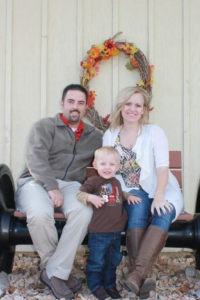
Lindsey with her family
We know there are so many types of nurses and nursing jobs in this world. We at ScrubShopper thought it would be fun and helpful to profile a few real nurses so that you can see what “a day in the life” is like.
Today we talked to Lindsey.
1. What kind of nurse are you?
I work in ICU and teach clinicals for the local university. I also work PRN for a home health agency and teach a nursing review during Christmas and summer breaks.
2. How would you describe what you do?
Rewarding. I love nursing because there is such a variety of what you can do.
3. What does a typical work day look like?
Depends on the job. I work most as a clinical instructor. So, I usually start my day at 6:30 a.m. and end at 3:00 p.m. or 7:00 p.m., depending on the shift. I assign my students areas to work in that day and follow them, making sure they are engaging and learning. I love teaching, and this job never has a dull moment.
4. Why did you choose to be a nurse?
Because I knew there was a variety of what I could do . . . and job security!
5. What do you like about your work?
I know it sounds silly . . .but helping people : )
6. What do you dislike?
Two words . . . poop and vomit . . . lovely.
7. How much money did you make starting out?
$22 per hour
8. What is the most challenging part of what you do?
Long shifts and emotionally draining at times
9. What is the most rewarding?
In ICU, I literally have a person’s life in my hands. It is very stressful and emotionally hard, but so amazing at the end of the day when I know because of my skills and knowledge, that I have saved a person’s life!
10. What is a common misconception people have about what you do?
That all I do is clean up people and give sponge baths. Yes, I have to do that, but there is so much more to nursing.
11. What goals/plans do you have for the future?
I would like to get my APN. I have my Master’s degree in nursing, but would like to take my boards for my APN.
12. What else do you think someone who is considering nursing as a career should know about what you do?
There is no way you could ever get bored with nursing. There are SO many things to do with this degree. Just look at my list of current jobs. I am NEVER bored!
Thank you so much Lindsey!
If you are a nurse and would like to share your experience with future nurses, we’d love to talk to you. Email smccratic (at) acumenholdings (dot) com.
Real Life: Working Two Jobs (Hospital Floor Nurse & Clinicals Instructor)
Jeannette and her husband
We know there are so many different nursing jobs out there, and we know that some of you are still in school, so we thought you might like to see what it’s really like working in the field on a daily basis in different roles. Today we talked to Jeannette who works two jobs as a nurse. She’s also a new mom.
1. What kind of nurse are you?
I work two different jobs as a nurse. I work as a “floor nurse” at Washington Regeional Medical Center (WRMC) as a progressive care cardiac nurse, which I have done since I graduated, and I also teach clinicals to nursing students to the University of Arkansas.
2. How would you describe what you do?
When I work at WRMC I take care of patients with cardiovascular problems such as a recent heart attack, congestive heart failure, or peripheral vascular disease to name a few.
When I teach I have a group of 7 or 8 students. We spend some time in lab learning how do perform different nursing skills and then we move to the hospital where they learn to care for these patients. They get to practice skills learned along with seeing first hand how many disease processes affect patients. They learn to apply textbook lectures to hands-on care.
3. What does a typical workday look like?
At WRMC, I care for 5 to 6 patients during my 12-hour shift. I start off by getting report from the off going nurse, once that is complete I start my day. I assess each patient, give scheduled medications, perform physician ordered tasks, which may be wound care, inserting a Foley catheter, assisting a patient walk around the unit, or simply bathing a patient. Each patient is different and each requires individualized care. All care is charted proficiently. I end my day handing off my patients to the oncoming nurse.
When I have my students, I am constantly observing them to see how well they are learning to be a nurse. I assist however needed, perfecting a head-to-toe assessment, quiz them on medication, and educate them on any area they are unsure about.
4. Why did you choose to be a nurse?
One day when I was maybe 15 or 16, nursing became my career choice. I had always been interested in caring for people and learning how to treat different ailments. My parents had the book, “Doctors Book of Home Remedies” and I remember reading about all sorts of treatments. My parents were and still are first responders for their community and I would attend their first aid training classes. As soon as I was old enough I was certified in CPR and would go with them on calls. When I graduated high school I knew what I wanted to major in in college, unlike many of my friends who were undecided. I have never regretted my decision.
5. What do you like about your work?
I love treating patients, and learning something every day. There are always new evidence-based studies coming out explaining better ways to treat patents. I try to work smarter not harder, meaning I want to make sure what I am doing is what is best for my patient and not going to cause more problems later.
To have a patient tell me how grateful they are for the care I have given makes everything worthwhile.
6. What do you dislike?
I hate seeing patients who seem to not care about their own health and who are patients of mine repeatedly because they are non-compliant with medications, physician instructions, or diet. It makes my care seem pointless when they don’t take initiative to better themselves.
I also hate when a patient dies. There are instances when a death is expected and the patient is “ready,” Then there are those times when a patient codes, everything is done, but they don’t make it though. Those are hard to deal with but what’s worse is I’ve become kind of dead to that, and it doesn’t affect me as bad as it once did. Over time, I have learned to deal with difficult situations and not let it affect me. Don’t get me wrong, I will still sit down with a patient that is dying and have utter sympathy for them and may even cry with them and the family, but death is something I have learned to respect.
7. How much money did you make starting out?
I don’t remember the exact amount, at WRMC I want to say somewhere around $18.50/hr. As I became certified in many things my pay went up. Each year I have received a raise based off my yearly evaluation.
Where/what you do will vary your pay rate.
8. What is the most challenging part of what you do?
Goes back to my answer about what I dislike about my job, keeping a positive front at all times no matter what is going on with my patients. Patients can be down right hateful and non-compliant. Trying to treat someone who could care less is very challenging.
9. What is the most rewarding?
I love when a patient comes in very, very sick and after treatment returns to their normal self. I think back to a patient who was about 85 years old and wanted to be able to work in her garden. She needed to have open-heart surgery but her age alone put her at a major risk for complications. She had her surgery, did wonderful, went home and got to start her garden.
I also love watching new nurses grow to become excellent nurses. The first year after graduation is scary, but with proper guidance they build confidence and learn to critical think and provide wonderful care.
10. What is a common misconception people have about what you do?
That nurses are subordinate to doctors, and must do whatever the doctor says.
Nurses do require physician orders for most of what we do, but we are also patient advocates. We sometimes have to question a doctor’s order or decision. Nurses need to make sure patients are well informed at all times about everything that is going on or planned. It may be questioning if a patient really should have surgery or a procedure that will potentially hurt the patient more than benefit the patient. Nurses are always the first ones blamed as soon as something goes wrong.
11. What goals/plans do you have for the future?
I have applied to UAMS to get my masters degree. I plan to study Family Health and get my Family Nurse Practitioner license. I will only be able to do this at a part time rate, so it will take me about 4 yrs to complete.
12. What else do you think someone who is considering nursing as a career should know about what you do?
Know that it is a stressful job and carries a lot of responsibility, but more times than not the rewards outweigh the bad times.
Thanks Jeannette!
If you would like to be featured on ScrubShopper.com or you know of a nurse we should interview please contact us. We love learning from you!
- Stephanie
smccratic (at) acumenholdings (dot) com
Top 25 Nurse Blogs
It’s common knowledge that nursing is one of the fastest growing professions in the United States. The allure of nursing isn’t limited to a healthy paycheck and prestigious job title though. Ask any nurse and they’ll tell you that involvement in the nursing professions gives way to a whole new lifestyle. Yes, it’s hectic, messy, hard work. The rewards that go with the job are well worth it though. Nurses get to make a difference in the lives of people every day, assisting families and patients in some of the most difficult situations they’ll ever encounter. Our list of top 25 nursing blogs consists of blogs that are written by nurses and reflect the whole lifestyle associated with nursing. Some talk about work. Some talk about patients. Some talk about striving for balance with a nurse’s schedule. We hope this list gives nursing students and those who enjoy reading the experiences of fellow medical professionals greater insight into the daily happenings of real nurses.
Happy Reading!

Real Life: OB/GYN Clinic Nurse
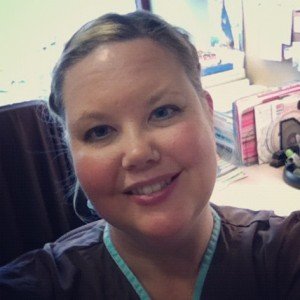
Alison at work
We know there are so many types of nurses and nursing jobs in this world, so we thought it would be fun and helpful to profile a few real nurses so that you can see what “a day in the life” is like.
Today we talked to Alison. Here is her story.
1. What kind of nurse are you?
I am a registered nurse (RN) with a bachelor’s degree in nursing. I work as a physician’s nurse in a private practice, OB-GYN clinic.
2. How would you describe what you do?
I am responsible for overseeing the care of all of my doctor’s patients. I answer their questions when they call in, assess their problems over the phone to report the the doctor, arrange referrals, order diagnostic tests, explain test results, schedule appointments, procedures and surgeries, and refill medications. When my doctor is seeing patients in the clinic I am often assisting with the patient exam and/or procedure, giving injections, removing staples on post-op patients, performing non-stress tests on pregnant patients, assessing vital signs and taking new patient histories. If my doctor is caught in the operating room or on Labor and Delivery I might see a scheduled patient for their routine prenatal exam so that they don’t have to wait for a long time or have to reschedule their appointment.
3. What does a typical workday look like?
I clock in at 8 AM. I have about 45 mins before we start seeing patients. During that time I am making phone calls and sorting through incoming test results. From 8:45 AM to noon we are seeing patients. During that time I am still trying to call patients with results and answer incoming patient calls, take new patient histories, prep patient’s for their visit (vital signs, updating their current medications/allergies and health history), assist my doctor in the exam rooms, and clean the exam rooms for the next patient. I have an amazing medical assistant that performs the bulk of keeping the patient flow going so that my doctor can go from patient to patient with little interruption. At our lunch break I race to our hospital cafeteria, grab something and eat at my desk while trying to catch up before our afternoon patients start arriving. We then see patients from 1:30 PM to closing, which is 4:30 PM. From 4:30 until 5 PM I am wrapping up some last minute work. In August 2011 we implemented an electronic medical record (EMR) system. Since that time I have been working on extracting our patients’ medical history from their paper chart and entering the information into our EMR. I run home from 5-6 PM to take care of my pets, grab some dinner and return to the office by 6:30 PM. From 6:30 until sometimes 8-10 PM I am preparing charts and reviewing what will be needed for the next day. I am hoping as we get closer to the 1 year anniversary of EMR that the majority of our patients will be on the EMR so that I have less chart extraction to do and will be able to have a life again!
4. Why did you choose to be a nurse?
My father is a pharmacist and I grew up in our small-town Iowa drugstore. I always thought that I may carry on the tradition and become a pharmacist like my dad. Unfortunately chemistry has never been my strong suit so I decided to take on what seemed to be the next best thing…nursing. At the age of 17 I became a certified nursing assistant and started working at a large nursing home in Sioux City, IA. At the age of 17 I passed the necessary testing to be a certified First Responder so I could respond to 911 calls or other ambulance calls in my hometown. During this time I also obtained my lifeguard certification and worked at our local swimming pool and gave private swim lessons. These experiences were just the natural progression toward starting college at South Dakota State University and applying for the nursing program my sophomore year. 2 1/2 years later I was graduating, taking my boards and looking for my first “real” job!
5. What do you like about your work?
I have a lot of autonomy in my position so I am able to think for myself and execute decisions with the support of my physician. I like that my patients know it’s me on the phone when they call and that I will be at their side when they come in. They also have faith in me that I will take care of what they need. It means a lot to me to have a relationship with my patients. I have cared for some of these women since I started in my clinic in 1998.
6. What do you dislike?
Lately the long hours and working short staffed.
7. How much money did you make starting out?
Ummm, not a lot…less than you would probably think.
8. What is the most challenging part of what you do?
I want to take care of everyone and everything immediately but realistically I have to prioritize. Everyone has to wait their turn.
9. What is the most rewarding?
Knowing I was there for someone, especially when they may not have had anyone else to turn to. Thankfully I also get to be a part of many people’s joy as well!
10. What is a common misconception people have about what you do?
That being a “clinic nurse” is easy! Many believe that when the clinic closes I get to go home. They don’t realize all the extra hours I am there in the evenings and on the weekends. Even nurses that have worked in the hospital and take a job in our office are shocked by the amount of work that our job entails.
11. What goals/plans do you have for the future?
I’m thinking about going back to school for my master’s degree. I’m kicking around the Nurse Practitioner gig.
12. What else do you think someone who is considering nursing as a career should know about what you do?
Working in a specialty practice is a very demanding job. It requires a great deal of dedication, responsibility, organizational skills, and the ability to move fast and think for yourself.
Thanks Alison!
If you would like to be profiled or you know of a nurse we should interview please email us. We love to hear your stories.
- Stephanie
smccratic (at) acumenholdings (dot) com
Popular on Pinterest This Week
We love Pinterest!
What about you? Are you a pinning fool yet?
This week our fans were busy pinning their favorite Scrub Shopper items, so we thought it would be fun to share the most-pinned items of the week here.
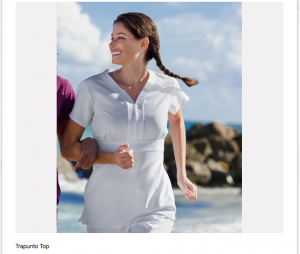
Trapunto scrub top (available in tons of gorgeous colors)

MedCouture scrub pants. So cute!
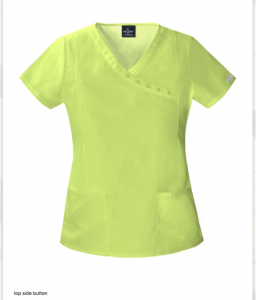
Baby Phat Mock Wrap top in Citrine
It looks like spring is in the air! These colors are so fun. Happy pinning everybody!
You Know You’ve Been In The Medical Field Too Long When…
You know that you have been in the medical field too long when…
1) You know to remain seated until everyone is done eating at your lunch table in the hospital cafeteria. Because you’ve learned- the cafeteria is a gossip mill. If you are the first person to finish lunch and take your tray to the kitchen, everyone starts talking about you.

2) You one day realize you haven’t slept past 9 AM in years. You’re always up early for work and your body can’t seem to stay in sleep-mode for very long even on weekends. Stupid internal clock.
3) You’ve developed bad back problems from dentistry by leaning over to see into patients’ mouths all day.
4) You have a love/hate relationship with your pager. You won’t leave anywhere without it, but you dread getting called in on weekends.
5) You know how valuable caller ID is. You know when to pick up the home phone, having strategically memorized the patients that call and only want drugs from the patients’ names that genuinely probably need help.
6) You frequently get asked the question, “are you ever going to retire?!”
7) You aren’t surprised by any case thrown at you. You’ve seen it all and something you would have thought was outrageous 5-10 years ago just isn’t weird anymore.
What about you? What made you realize that you have been in the medical field too long? Let us know!
Photo credit: Bradley Gauthier
High School Students Exploring a Career in Dentistry
Dentistry is a career that might be hard to be confident about until you have actually had practice. It is also a career that is often very limited, if at all existent, in smaller towns.
But in Maine, high school students are getting the chance to have a hands-on experience. The purpose is to hopefully encourage teens from rural areas to pursue careers in dentistry, then return to their small towns and provide services that are typically limited to the bigger cities.
And, don’t worry, their hands-on experience involves practicing on mannequins.
For the full story from the Portland Press Herald, click here.
Medical Stories
My friend is a dentist working in a state hospital and he let me in on some interesting medical stories from his job. These three stories are touching and some are funny. Enjoy!
A 78-year-old female patient with Alzheimer’s disease draws and colors me a picture with color crayons for every dental appointment. She carefully explains what everything in the picture is. ”Now this is a tree. Now this is a house. This is a window.” She appreciates my approval about each object in the picture. I say things like: ”Oh, wow, that is a beautiful window.” I find that if I get down on my patients level, make eye contact, and speak very softly, I get a lot more cooperation, and they don’t feel threatened. Working at a state hospital is a tough, but very rewarding job.
A woman with slight mental retardation and some emotional problems, in the middle of treatment, will start singing a hymn. She has a beautiful voice, and my assistant and I just back our chairs away from the patient’s treatment chair. We listen until she finishes her song. I tell her how beautifully she sings, and that her hymn reminds me of church songs I grew up with. She thanks me for the compliment, and we go back to work and finish the dental procedure. Although I need to get to other patients, I don’t mind sitting back to listen to her sing. It’s beautiful to see how she can find simple joys in her old age like that.
Some of the patients are so unstable, they experience delusions of grandeur. These patients make me laugh because the things they say are just so out there, and yet they say them like its 100% true. One patient says he owns ALL the Walmart stores in the northern part of the state. Another patient says she owns every ToysRUs in Oklahoma, and another one announces she OWNS the state-owned building we work in. I told that patient, “Nice building you’ve got here. I like working in your building.”
