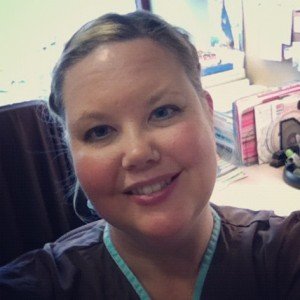
Alison at work
We know there are so many types of nurses and nursing jobs in this world, so we thought it would be fun and helpful to profile a few real nurses so that you can see what “a day in the life” is like.
Today we talked to Alison. Here is her story.
1. What kind of nurse are you?
I am a registered nurse (RN) with a bachelor’s degree in nursing. I work as a physician’s nurse in a private practice, OB-GYN clinic.
2. How would you describe what you do?
I am responsible for overseeing the care of all of my doctor’s patients. I answer their questions when they call in, assess their problems over the phone to report the the doctor, arrange referrals, order diagnostic tests, explain test results, schedule appointments, procedures and surgeries, and refill medications. When my doctor is seeing patients in the clinic I am often assisting with the patient exam and/or procedure, giving injections, removing staples on post-op patients, performing non-stress tests on pregnant patients, assessing vital signs and taking new patient histories. If my doctor is caught in the operating room or on Labor and Delivery I might see a scheduled patient for their routine prenatal exam so that they don’t have to wait for a long time or have to reschedule their appointment.
3. What does a typical workday look like?
I clock in at 8 AM. I have about 45 mins before we start seeing patients. During that time I am making phone calls and sorting through incoming test results. From 8:45 AM to noon we are seeing patients. During that time I am still trying to call patients with results and answer incoming patient calls, take new patient histories, prep patient’s for their visit (vital signs, updating their current medications/allergies and health history), assist my doctor in the exam rooms, and clean the exam rooms for the next patient. I have an amazing medical assistant that performs the bulk of keeping the patient flow going so that my doctor can go from patient to patient with little interruption. At our lunch break I race to our hospital cafeteria, grab something and eat at my desk while trying to catch up before our afternoon patients start arriving. We then see patients from 1:30 PM to closing, which is 4:30 PM. From 4:30 until 5 PM I am wrapping up some last minute work. In August 2011 we implemented an electronic medical record (EMR) system. Since that time I have been working on extracting our patients’ medical history from their paper chart and entering the information into our EMR. I run home from 5-6 PM to take care of my pets, grab some dinner and return to the office by 6:30 PM. From 6:30 until sometimes 8-10 PM I am preparing charts and reviewing what will be needed for the next day. I am hoping as we get closer to the 1 year anniversary of EMR that the majority of our patients will be on the EMR so that I have less chart extraction to do and will be able to have a life again!
4. Why did you choose to be a nurse?
My father is a pharmacist and I grew up in our small-town Iowa drugstore. I always thought that I may carry on the tradition and become a pharmacist like my dad. Unfortunately chemistry has never been my strong suit so I decided to take on what seemed to be the next best thing…nursing. At the age of 17 I became a certified nursing assistant and started working at a large nursing home in Sioux City, IA. At the age of 17 I passed the necessary testing to be a certified First Responder so I could respond to 911 calls or other ambulance calls in my hometown. During this time I also obtained my lifeguard certification and worked at our local swimming pool and gave private swim lessons. These experiences were just the natural progression toward starting college at South Dakota State University and applying for the nursing program my sophomore year. 2 1/2 years later I was graduating, taking my boards and looking for my first “real” job!
5. What do you like about your work?
I have a lot of autonomy in my position so I am able to think for myself and execute decisions with the support of my physician. I like that my patients know it’s me on the phone when they call and that I will be at their side when they come in. They also have faith in me that I will take care of what they need. It means a lot to me to have a relationship with my patients. I have cared for some of these women since I started in my clinic in 1998.
6. What do you dislike?
Lately the long hours and working short staffed.
7. How much money did you make starting out?
Ummm, not a lot…less than you would probably think.
8. What is the most challenging part of what you do?
I want to take care of everyone and everything immediately but realistically I have to prioritize. Everyone has to wait their turn.
9. What is the most rewarding?
Knowing I was there for someone, especially when they may not have had anyone else to turn to. Thankfully I also get to be a part of many people’s joy as well!
10. What is a common misconception people have about what you do?
That being a “clinic nurse” is easy! Many believe that when the clinic closes I get to go home. They don’t realize all the extra hours I am there in the evenings and on the weekends. Even nurses that have worked in the hospital and take a job in our office are shocked by the amount of work that our job entails.
11. What goals/plans do you have for the future?
I’m thinking about going back to school for my master’s degree. I’m kicking around the Nurse Practitioner gig.
12. What else do you think someone who is considering nursing as a career should know about what you do?
Working in a specialty practice is a very demanding job. It requires a great deal of dedication, responsibility, organizational skills, and the ability to move fast and think for yourself.
Thanks Alison!
If you would like to be profiled or you know of a nurse we should interview please email us. We love to hear your stories.
- Stephanie
smccratic (at) acumenholdings (dot) com